
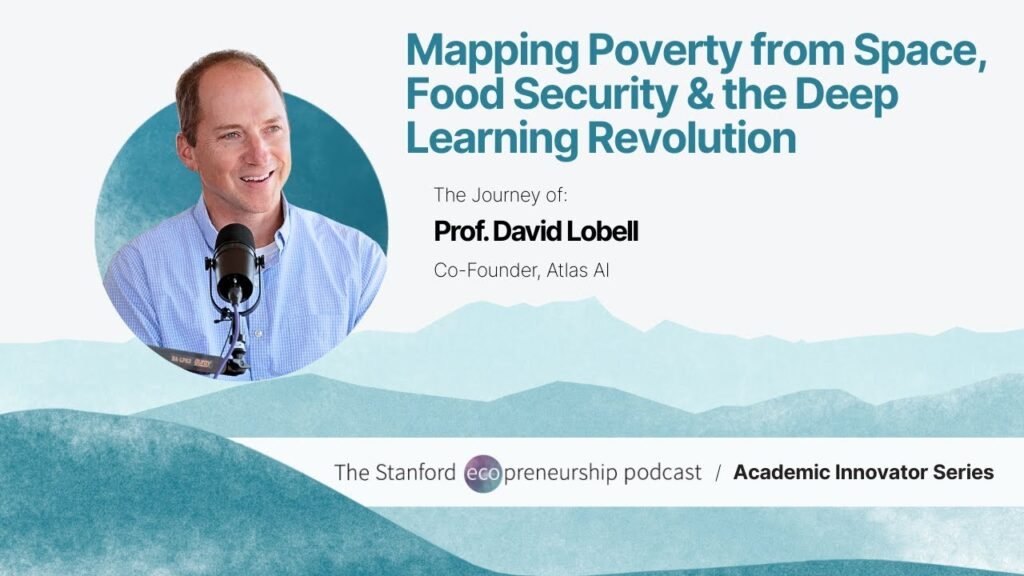


Stanford Professor David Lobell was using satellites to measure things like crop efficiency and greenhouse gas emissions when he was approached by fellow Profs. Marshall Burke and Stefano Ermon.
“Marshall came to me and said, I know you’re doing all this cool stuff in agriculture with remote sensing, but I’m trying to get information on poverty, and it seems like you should be able to tell me something about poverty when you’re looking from space,” Prof. Lobell recalls. He, Burke, and Ermon went on to found Atlas AI, which applies satellite data and artificial intelligence to deliver insights on food security, poverty, and sustainability.
In this episode of the Stanford Ecopreneurship Podcast, Prof. Lobell talks with Sam McClure about:
– How satellite data unlocked new frontiers in measuring food security and poverty in developing regions
– Why all three co-founders stayed on faculty — and what they wish they’d known before they started
– And how Atlas AI functions as a public benefit corporation, or PBC
Chapters:
00:00 – Introduction
02:17 – Applied Math & Finding Environmental Science
05:01 – Early Satellite Projects
10:08 – Political Cycles & the Shift to Climate
12:31 – Europe’s Rise in Geospatial
14:47 – What Satellites Can Measure in Agriculture
17:07 – The Origins of Atlas AI
23:58 – Rockefeller, Raj Shah, and the Dinner That Changed Everything
30:27 – Becoming a Public Benefit Corporation
35:29 – Three Professors, One CEO: How the Team Works
39:34 – Finding a CEO Without a Network
42:16 – Early Struggles & Measuring Impact
48:28 – Advice for Faculty Founders
Atlas AI: https://www.atlasai.co/
David Lobell: https://profiles.stanford.edu/david-lobell
Doerr School spotlight video about Prof. Lobell: https://www.youtube.com/watch?v=sugEt9ACtYc
Sam McClure: https://law.stanford.edu/sam-mcclure/
Produced and edited by Eric Johnson from https://lightningpod.fm
This podcast was developed and published by Stanford Ecopreneurship: https://ecopreneurship.stanford.edu/
Source


